⚡ Practical AI · @TheRealPearsonified
Practical AI · Deep Dive
Google Became
The Website.
What Google actually changed in your search this month — and what it means if you have a business or buy ads.
The News
Google just had the biggest
two weeks for Search in years.
Let's separate it cleanly: what we already told you · what's brand new · what actually changed.
What we already covered · Ep42 (May 22)
We told you it was coming.
- Google I/O launched AI Mode + the biggest search-box redesign in 25 years
- The Gemini agent layer baked into Search
- AI Mode crossed 1 billion users
That was the announcement. Here's what happened since.
What we did NOT cover · the last 2 weeks
This is the new meat.
- "Preferred Sources" + "Highly Cited" badges went live (May 27)
- The May 2026 core update finished — a big, volatile ranking shake-up (June 2)
- First real usage data: queries 3x longer, follow-ups up 40%
- Ads moved INSIDE the AI answer (Google Marketing Live, May 20)
- And the number nobody's saying out loud: 93% zero clicks
Zoom in · the part nobody explains
Google changed
who gets found.
- A few times a year Google overhauls its ranking algorithm — a "core update"
- This one ran 12 days (May 21 → June 2). Rankings swung the whole time — businesses watched traffic bounce up and down
- SEOs say it demoted cheap, mass-produced AI content. Google won't confirm that — they just call it a "quality update"
The wild part to sit with: the spam is written by AI. The system catching it runs on AI too. Google is using AI to police AI — and won't tell you the rules.
What actually changed · in one sentence
Google stopped sending you
to websites.
It became the website.
Let me show you exactly what I mean. I ran a real search this week. →
The proof · a real search
I asked Google:
"how to grow easy
plants with kids."
Simple. The kind of thing you'd normally click 3 or 4 sites for. Watch what I got instead. →
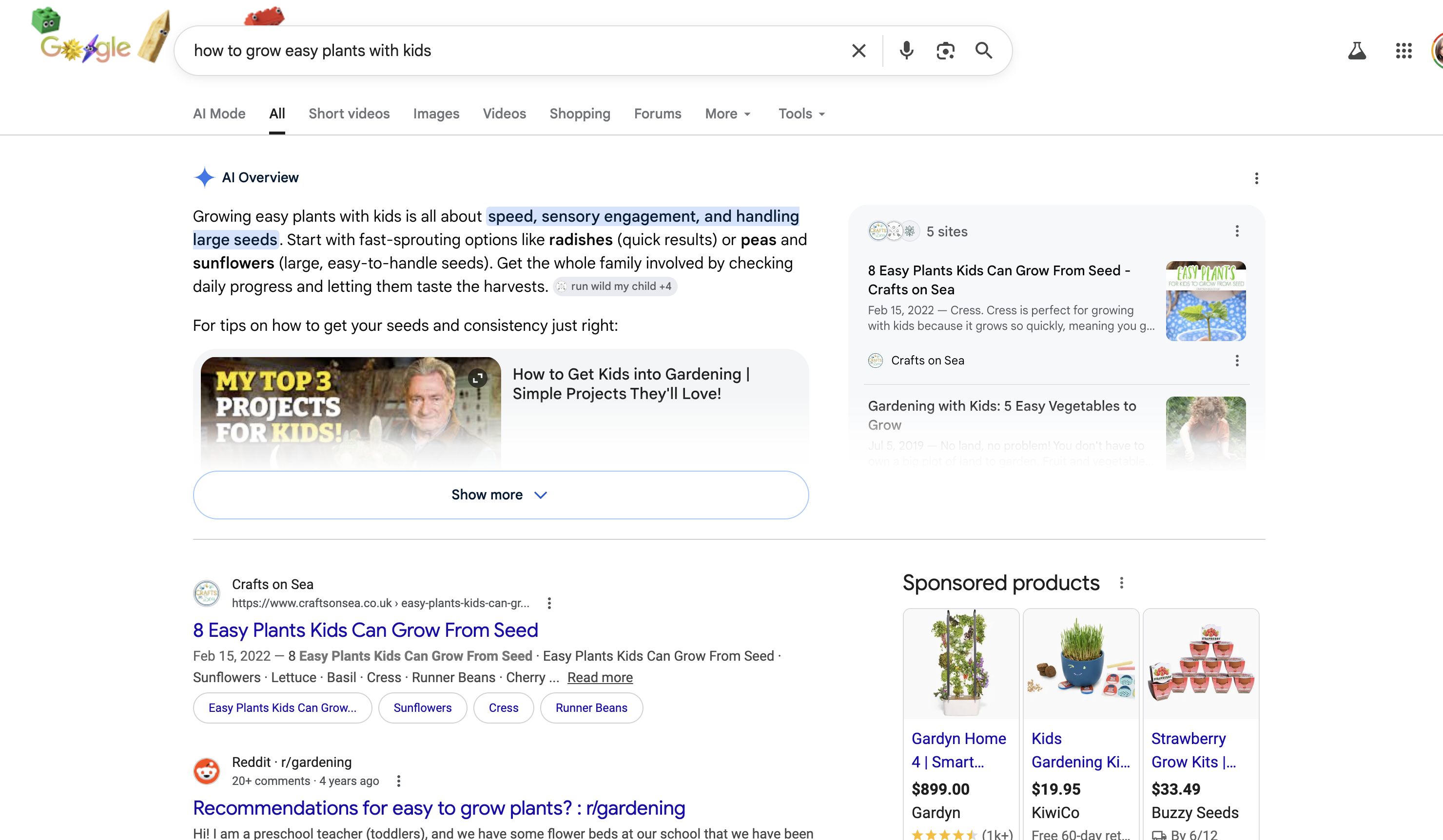
One screen. The full answer, written for me. I never clicked a single website.
What's actually on that screen
Everything used to be 10 blue links.
Now it's one answer.
- AI Overview wrote the whole answer — plants, tips, how-to
- 6 sites "cited" on the side — I saw their names, never visited them
- It even pulled in Reddit (r/gardening) — a human forum
- Sponsored products ($899 Gardyn, $16.95 kit) sitting right in the result
Answer + sources + ads, all in one screen. The click is gone.
The number that should scare every business
93%
of Google AI Mode searches now end with zero clicks to any website. People get the answer and move on.
And it's not a test — it's everyone
2.5B
see AI Overviews/month
3×
longer queries
than old search
The blue-links Google you grew up with is basically gone.
Three things flipped at once
One results page
→ Personalized to you
If you spend money on Google Ads — this part's for you
So what happens to
your ad budget?
Google answered this at Google Marketing Live (May 20). Here's the nitty-gritty.
How they charge you
Same auction. New real estate.
- No new pricing model — it's still the cost-per-click auction you know
- Your ads now appear inside, above, and below the AI answer itself
- Eligibility flows through your existing Search / Shopping / PMax — no separate bid
- Judged on conversions / ROAS, not clicks — because the clicks are drying up
Straight answer: Google has not published a CPC premium for AI placements. Anyone quoting a specific "% more expensive" is guessing — that's a third-party estimate, not Google.
How you actually pay — and what changed
You still pay per click.
But you stopped setting the price.
THEN
You set the bid:
"$2 a click."
You picked what a click costs.
NOW
You set the target:
"$40 to win a sale."
Google's AI bids on each click to hit it.
To be clear: the $40 is not a fee. It's your ceiling — the most ad money you'll spend to land one customer. Google works the clicks to keep you near it. You're still billed per click, and there's no "pay per AI answer."
The new ad formats living inside the answer
Ads that talk back.
- Conversational ads — an ad that reasons with the user inside AI Mode
- Direct Offers — your promo / bundle / checkout dropped into the chat
- AI Shopping ads — dynamic "why this product fits you" explainers
- Business Agent — a chatbot living inside your ad, answering questions
What it means for a heavy spender
You're handing the wheel
to Google's AI.
- Manual, keyword-heavy campaigns are dying for these new queries
- The path in is AI Max + Performance Max — keywordless, AI-placed
- Your edge moves to feeds, structured data, and creative assets
- Google's own numbers: AI Max +14% conversions · Performance Max +27%
The honest catch: better numbers, but you control less. You feed Google's AI and trust it to place you. That's the trade.
So the game changed
You're not fighting to rank.
You're fighting to be cited.
Google even added a "Highly Cited" badge. The source inside the answer wins now. Here are the 3 moves. →
1
Be the original source.
Google's "Highly Cited" badge rewards people who said it first. Stop rewriting what's already out there. Your real story, your real numbers, your first-hand experience — that's what the AI lifts and credits.
2
Show up where
humans gather.
My result cited Reddit. The AI pulls from where real people talk — communities, forums, short video. Be talked about by humans, and the machine repeats you.
3
Own a relationship
you don't rent.
When 93% never click, rented traffic is vanishing. Your email list, your community, your subscribers — that's the one audience an algorithm can't take from you overnight. Build the list.
The whole thing in one line
Stop optimizing for the
robot's cold discovery.
Become the thing humans repeat —
the robot follows.
Practical AI
The only show where you walk away
a little more irreplaceable
than you were last week.
Fridays, 11am CT · @thepearsonified
← → or click to advance · F = fullscreen
1 / 21